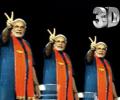
With hi-tech Narendra Modi at the helm of Bharatiya Janata Party's election campaign, its Mission 272 plus is all set to cash in on the popularity of the Internet and the social media. The Congress has a lot of catching up to do. Anita Katyal reports
As we observe Martyrs' Day today, Mahatma Gandhi would have been dismayed by the number of vested interests that are seeking to carve out identities and spaces outside the Republic of India, says Shreekant Sambrani.

We must repeal AFSPA to begin to heal Kashmir, and to enhance India's moral stature and that of the army, says Ajai Shukla

'N Ram and I met on the lawns of Mani Shankar Aiyar's bungalow.' 'I pulled out a rolled printout from my jacket and handed it to him.' 'In the cut-throat world of journalism, this was like high treason.' 'But letting a story be killed because you can't publish it is a bigger crime than passing it to the competition,' recalls Shekhar Gupta.
The West has always preferred a timid, half intelligent and a dependent India rather than a decisively independent and self-reliant one. A pliable Indian leadership suits the West best, says Tarun Vijay.
'Somewhere along the way, elected office-bearers appeared to have lost sight of the interest of cricket and begun to pursue their own interpretation of what the game should be.' 'Families made it a tradition to have their representatives occupy, if not usurp, positions in state associations,' points out Vinod Rai, who will step down as head of the BCCI's Committee of Administrators on Wednesday, October 23.

Unless the judges factor in the ungovernability of technologies and their beneficial owners, present and future Presidents, prime ministers, judges, legislators and officials handling sensitive assignments may become redundant with reference to their age-old roles for securing 'national resources and assets', warns Dr Gopal Krishna.
The days of political elite have ended with the advent of new politics and new media. Today every citizen is a politician, social worker and an intellectual, says Ram Madhav, BJP national general secretary.

Does India's first political family see some serious threat to its own bastions? The question was doing rounds in Uttar Pradesh, where lie Rae Bareli and Amethi -- the respective parliamentary constituencies of Congress president Sonia Gandhi and vice president son Rahul Gandhi. Sharat Pradhan reports.

'Biometric Aadhaar-based surveillance is not only about violation of privacy, but also about the treasure hunt for unprecedented financial surveillance and economic intelligence in the economic history of mankind,' asks Gopal Krishna.

Fali Nariman, one of India's best-known lawyers, tells Aditi Phadnis that plurality of political opinion is the only way to counter intolerance

Rahul Gandhi's press conference showed how cocooned he may be, that he does not brainstorm with a large enough group of party colleagues and senior leaders. But it also showed how difficult it is going to be to reform an entrenched organisation like the Congress from within, says Neerja Chowdhury.

'Like Robespierre,' argues Syed Firdaus Ashraf, 'Kejriwal too talks of virtue, and the ones who speak out against him will encounter the terror of Kejriwal's wrath in the Aam Aadmi Party.'

Aadhaar-related schemes and the Aadhaar Act exist on the assumption that Right to Privacy is not a Fundamental Right.
Chief economic advisor Arvind Subramanian discusses the Budget, goods and services tax, Centre-state relationship and larger issues facing the economy
.jpg)
Crony capitalism will of course generate investment and ensure profit for private capital, but it won't give employment or income to the people. If you can make money by selling coal or speculating in land, why produce electricity, why invest in research and development, why even set up factories, asks Praful Bidwai.

Students will have more H1Bs to count on after they graduate.

The Bill at best makes the existing public distribution system a legal right, an aspect that seems of little consequence to the lords of high finance, whose primary anxiety is the FSB-by-numbers.
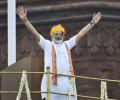
Following is the full text of Prime Minister Narendra Modi's address from the ramparts of the Red Fort on the 73rd Independence Day.

'It is good for the country, but it is not good for a politician... What we call impatience is actually desperation to needing something NOW.' 'Our politics is restricted by one factor; that our Parliament is full of villages. 40% of the country now lives in cities but only 25% of Parliament is coming from the cities.'

'If Facebook were a country, it would be the third most populous one and the most connected.'

'It is in the interest of both sides that the visit of the US President is seen as being successful. Both sides have invested considerable political capital in it. This rapid exchange of visits and the decisions taken have to be justified, beyond the symbolism, which is no doubt important in itself. This opportunity to impart a fresh momentum to ties should not be missed,' says former foreign secretary Kanwal Sibal.

'India could become the newest Asian tiger under Modi's dynamic leadership. Modi could become the Nehru of the 21st century, and re-establish a new Tryst with Destiny, by stating once and for all that Mera Bharat Mahaan is and will always be a truly secular and inclusive democracy in the best spirit of Bharatiya-tva,' says Ram Kelkar, offering an NRI view of the Modi triumph.
NSA Menon's wisdom says that the idea to be superpower is not really desirable, it is better to be different. Sheela Bhatt reports.

'This generation has seen no communication.' 'You have not given them any stake.' 'They don't have a feeling of belonging.' 'They have only seen a man in uniform with a gun.' 'That is why it is taking a more vicious form today -- the attacks on the security forces and the retaliation is causing heavy loss of lives.'

'When Sultan released, I got greedy. I decided to make another film with Salman because he gets me a lot of box office.'

Talmiz Ahmad is a former Indian ambassador to Saudi Arabia, Oman and the UAE. In an interview with Aditi Phadnis, he says the disequilibrium in Iraq will continue to prevail. Ahmad also says there are indications that the US is now anxious to avoid intervening militarily in West Asia, and that this is the appropriate moment for Asia to assume responsibility for its own security. Edited excerpts:

'When there are two hostile armies operating in close proximity, moral ascendancy is very important -- and that is something, I think, we achieved.' 'What is important is the will and determination of a country.' 'That you are willing to do something about terror that is coming from across the border and that is the message that was sent out.'

More than a year after he was nominated by President Barack Obama, the US Senate, defying the powerful pro-gun lobby National Rifle Association, voted to confirm Dr Vivek Hellegere Murthy as the first Indian American US Surgeon General and the youngest ever at age 37, in a cliff-hanger of a 51-43 vote.
On the eve of the release of his book, 2014: The election That Changed India, Rajdeep speaks candidly in an interview with Sheela Bhatt/Rediff.com.

BJP President Amit Shah -- arguably the second most powerful politician in the nation -- granted a rare television interview to the Network 18 group of news channels. Rediff.com's Rajesh Alva checks out what the BJP boss said in this word cloud assessment of the interview.
When Rajni Kothari pointed towards a new democratic alignment in India.

The finance ministry is not only keen to split the roles of CMD, but also wants to appoint them for a fixed tenure of five years.

I-T lens on current account deposits over Rs 12.5 lakh. All the news and more post demonetisation.

Here's how India's most successful film star goes about his work.

The new ordinance on land acquisition will allow land grabbers to deprive millions, destroy agriculture, horticulture, rivers, forests, tree cover and mangroves to extract minerals as well as ground water, without replenishment at a pace that will not leave anything for the next generation, warns activist Medha Patkar.

At the 53rd annual convocation ceremony of the IIT-Bombay, Nobel laureate Kailash Satyarthi shared stories of his struggle and victories.

The elements are all aligned to make India a global powerhouse, says IMF Managing Director Christine Lagarde.

'If fame, money and comfort are the only factors that drive us, then we are playing cricket for entirely the wrong reasons.'
 © 2026 Rediff.com - Advertise with us - Disclaimer - Privacy Policy - Sitemap - Feedback - About us - Terms of use - Grievances